

What Is Nixodine? The Complete Guide for Vapers and Retailers (2026)
Estimated 0 min read
Author: Jonhattan Da Silva October 5, 2026
If you have picked up a high-capacity disposable vape recently and noticed the word "Nixodine" on the packaging where the nicotine strength would normally appear, you are not alone in wondering what it means. It is not a flavor. It is not a device brand. It is the active ingredient, and understanding it is what separates a confident purchase from a blind one.
This guide covers everything: what Nixodine actually is at a chemical level, how it differs from nicotine and from standard zero-nicotine vapes, what the published research says, where its regulatory status stands in 2026, and which Nixodine products are available at VapeRanger for wholesale buyers.
Table of Contents
- Quick Answer: What Is Nixodine?
- The Science Behind Nixodine: What It Actually Is
- How Nixodine Differs from Nicotine
- How Nixodine Compares to Standard Zero-Nicotine Vapes
- Nixodine vs. TFN (Tobacco-Free Nicotine)
- What Does Nixodine Feel Like to Vape?
- What Does the Research Say?
- Nixodine and Habit Formation: What to Know
- The Regulatory Status of Nixodine in 2026
- Who Are Nixodine Products For?
- Frequently Asked Questions
Quick Answer: What Is Nixodine?
Nixodine is a patented, nicotine-free compound developed by an American company called Bonguard Naturals. Its technical name is (S)-6-methylnicotine, sometimes written as 6-MN or 6-methyl nicotine. It is a synthetic molecule that is chemically related to nicotine but is not nicotine. It does not contain nicotine from any source and is not derived from tobacco.
Nixodine is designed to provide a vaping experience that feels similar to nicotine-containing products, including a genuine throat hit, without delivering any actual nicotine into the body. It achieves this because it interacts with some of the same receptors in the body that nicotine does, but as a distinct molecule with a different chemical structure.
The key facts in plain language:
- Nixodine is NOT nicotine
- Nixodine is NOT derived from tobacco
- Nixodine is NOT FDA-approved or FDA-authorized
- Nixodine is NOT a smoking cessation product
- Nixodine is NOT a health product of any kind
- Nixodine IS a patented synthetic compound designed for adult vapers who want the experience of vaping without consuming nicotine
The Science Behind Nixodine: What It Actually Is
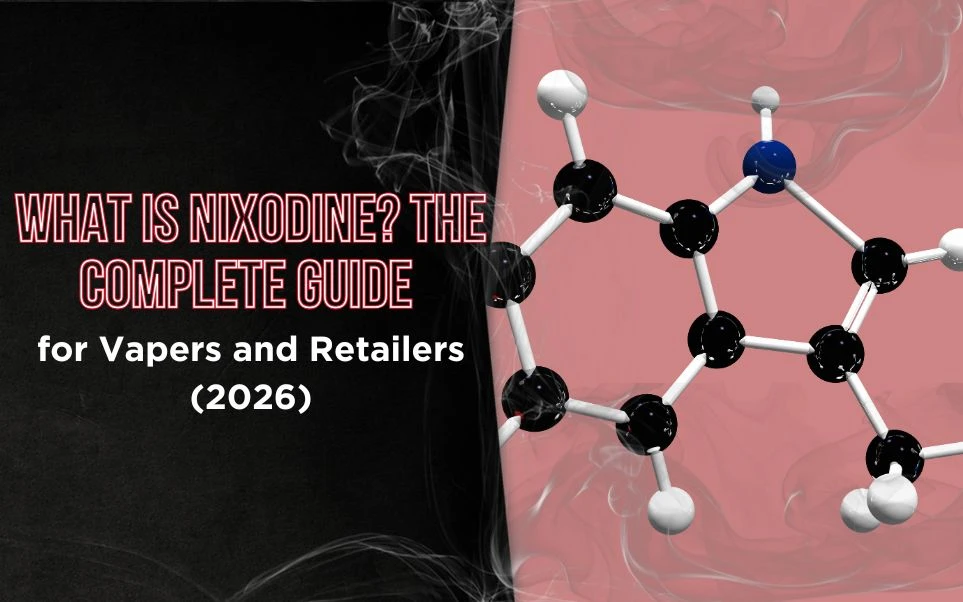
Nicotine, the compound found in tobacco, has the chemical structure of a pyridine ring attached to a pyrrolidine ring. It is the pyridine ring that drives most of nicotine's activity at the receptors in the body that produce its characteristic effects.
6-methylnicotine is structurally almost identical to nicotine, with one difference: a methyl group (a single carbon atom with three hydrogen atoms) added at position 6 of the pyridine ring. That single molecular addition is what makes 6-MN a distinct compound rather than nicotine, and it is the basis for the claim that Nixodine is not nicotine.
Bonguard Naturals, the Phoenix-based company behind the Nixodine brand, describes it as "a patented, flavorless concentrate containing (S)-6-methylnicotine" that is "chemically distinct from conventional nicotine and is not tobacco-derived." The intellectual property behind it is held by Ready Mix Naturals, LLC, a related entity that has successfully defended its patent portfolio in federal proceedings, with Bonguard Naturals resolving a patent matter as recently as September 2026.
Nixodine is synthesized from petrochemical precursors, not from tobacco plants. It arrives in the vaping supply chain as a concentrated, flavorless liquid that e-liquid manufacturers add to their formulas at the same volumes they would use for nicotine, making it a practical drop-in alternative for producing "nicotine-free" versions of existing products.
How Nixodine Differs from Nicotine
The most important differences between Nixodine and nicotine come down to three things: origin, structure, and the regulatory category each belongs to.
- Origin. Nicotine, including tobacco-free nicotine (TFN), originates from tobacco plants or is synthesized to be chemically identical to tobacco-derived nicotine. Nixodine is synthesized from petrochemical sources and shares no chemical identity with nicotine. It is a different molecule.
- Structure. The methyl group at position 6 of the pyridine ring is what separates the two compounds. That structural difference is small, but it is what places them in different regulatory and chemical categories.
- Regulatory category. Nicotine, whether tobacco-derived or synthetic, is regulated by the FDA as a tobacco product under the Family Smoking Prevention and Tobacco Control Act as amended in 2022. The FDA's authority extends to "products containing nicotine from any source." Because Nixodine is not nicotine and contains no nicotine from any source, it does not technically fall under the FDA's current nicotine regulatory framework. However, as discussed in the regulatory section below, this is an evolving situation and should not be interpreted as permanent regulatory immunity.
- Throat hit and receptor activity. Both nicotine and Nixodine interact with nicotinic acetylcholine receptors (nAChRs) in the body, specifically the alpha-4-beta-2 and alpha-3-beta-4 subtypes that are associated with the satisfying sensations of vaping. Research suggests that 1mg/mL of 6-methylnicotine can produce receptor activity comparable to 3mg/mL of conventional nicotine, meaning Nixodine may be more potent on a weight-for-weight basis at these receptors than nicotine itself.
How Nixodine Compares to Standard Zero-Nicotine Vapes
This is one of the questions that comes up most often, and the answer is the clearest case for why Nixodine occupies its own distinct category.
A standard zero-nicotine vape contains no active compounds of any kind beyond the base e-liquid ingredients (propylene glycol, vegetable glycerin, and flavoring). It produces vapor with full flavor but delivers nothing that interacts with the body's nicotinic receptors. The result is that most vapers who have been using nicotine products find zero-nicotine devices deeply unsatisfying, not because of flavor, but because the absence of any receptor activity makes each puff feel incomplete.
Nixodine changes that equation. Because (S)-6-methylnicotine interacts with similar receptors to nicotine, vaping a Nixodine product produces a throat hit and a sensory response that is meaningfully different from a plain zero-nicotine device. Users who have switched from nicotine products consistently describe Nixodine devices as feeling "real" in a way that standard zero-nicotine devices do not.
Here is a straightforward comparison:
The practical difference for the adult vaper is clear: Nixodine delivers what standard zero-nicotine cannot, and it does so without any nicotine.
Nixodine vs. TFN (Tobacco-Free Nicotine)
Tobacco-free nicotine, often abbreviated as TFN, is a different category entirely from Nixodine and is sometimes confused with it. The distinction matters.
TFN is chemically identical to nicotine derived from tobacco. It is synthesized in a laboratory rather than extracted from tobacco plants, but the final molecule is the same: it is nicotine. Because the 2022 amendment to the Tobacco Control Act extended FDA jurisdiction to synthetic nicotine, TFN is fully regulated as a tobacco product and requires PMTA authorization just like any other nicotine-containing product.
Nixodine is not TFN. It is not nicotine in any form. The two products serve a similar market, adult vapers who want to avoid tobacco-sourced ingredients, but they are chemically and regulatorily distinct. A retailer or consumer who has experience with TFN products should not assume that the Nixodine experience or the Nixodine regulatory situation is the same.
The simplest way to remember the difference: TFN is lab-made nicotine. Nixodine is not nicotine at all.
What Does Nixodine Feel Like to Vape?
This is the question that matters most to the end consumer, and the answer is consistent across multiple independent sources and customer feedback.
Nixodine delivers a genuine throat hit. This is the single most important functional difference from a standard zero-nicotine device, and it is what converts skeptical vapers into Nixodine users. The throat sensation is smooth, often described as cleaner or less harsh than a standard 50mg nicotine salt at the same labeled concentration. At 50mg Nixodine, the experience does not carry the scratchy throat sensation that some high-strength nicotine salt products produce, particularly in devices designed for weeks of daily use.
The Bonguard Naturals study published in August 2026 provides some scientific context for why Nixodine feels different from standard nicotine even when used at equivalent volumes: Nixodine-S "retained key receptor activity" comparable to nicotine at the satisfaction-related receptor subtypes while showing a different toxicological profile in laboratory conditions. The practical experience aligns with that: similar satisfaction signals, without the harshness.
Flavor reproduction on Nixodine devices is generally described as accurate and clean. Because Nixodine itself is flavorless, it does not interfere with the e-liquid's flavor profile the way that some nicotine formulations can. The fruit, mint, and candy profiles that dominate the top-selling Nixodine flavor menus tend to come through clearly and without the tobacco-adjacent undertone that some nicotine formulations add.
The experience is best described as: the ritual of vaping, the throat hit, the vapor, and the flavor, without the nicotine.
What Does the Research Say?
It is important to be precise about what the current research on Nixodine actually covers and what it does not.
- What the August 2026 Bonguard Naturals study found. A study published by Bonguard Naturals (funded by Ready Mix Naturals, LLC) evaluated Nixodine-S under OECD testing standards. The key findings were that Nixodine-S produced activity at the alpha-4-beta-2 and alpha-3-beta-4 receptor subtypes that was broadly comparable to nicotine (meaning it activates similar satisfaction pathways), while demonstrating lower cytotoxicity in vitro compared to nicotine. Specifically, nicotine's measured IC50 was 961.8 µg/mL, while Nixodine-S remained non-cytotoxic at the volume-equivalent of 2,000 µg/mL nicotine under the test conditions.
- What the academic research says. Peer-reviewed studies (Jabba and Jordt, 2024; Raghu et al., 2026 among others) have identified 6-methyl nicotine products in the U.S. market and raised questions about labeling accuracy and regulatory classification. Some formulations of products labeled as Nixodine have been found to contain both 6-methyl nicotine and nicotinamide (a form of vitamin B3). These studies have called for regulatory attention to this category.
- What is not yet known. Long-term safety data on inhaled 6-methylnicotine does not yet exist. The Bonguard Naturals study covers in vitro toxicology and receptor activity. It does not cover long-term respiratory effects, addiction potential, or clinical outcomes in human users. Bonguard Naturals has explicitly stated that Nixodine is not a healthcare product and is not approved as a cessation tool.
- The honest position. Nixodine is newer than any established vaping ingredient. The research is promising and ongoing, but anyone presenting Nixodine as a proven safe alternative is claiming more than the current evidence supports. It should be presented accurately: a novel nicotine-free compound with a growing body of research, designed for adult vapers who already use vaping products and want to continue without nicotine.
Nixodine and Habit Formation: What to Know
This is the part of the Nixodine story that requires the most careful, honest communication, particularly for retailers who will be explaining the product to customers.
Because Nixodine interacts with the same nicotinic acetylcholine receptors that nicotine activates, products containing it may be habit-forming. This is not a claim that Nixodine is addictive in the same way or to the same degree as nicotine. The pharmacology and the human behavioral research needed to make that comparison definitively do not yet exist. But it is an honest acknowledgment that a compound interacting with these receptor subtypes carries some potential for habitual use.
For customers who are vaping specifically to reduce or eliminate dependency, this is relevant information. Nixodine removes nicotine from the equation but does not guarantee a non-habituating experience. Retailers who present Nixodine as simply "habit-free" or "safe" are overclaiming. The accurate and honest position is: no nicotine, no tobacco, and an experience that may be habit-forming due to its receptor activity.
The Regulatory Status of Nixodine in 2026
The regulatory situation around Nixodine in 2026 is genuinely complex, and the complexity runs in both directions. It is neither a freely marketable product with no regulatory concern, nor is it a straightforwardly banned substance. Understanding where it actually stands requires separating the federal picture from the state picture.
At the federal level
The FDA's jurisdiction over tobacco products was extended to synthetic nicotine in 2022. Because Nixodine is (S)-6-methylnicotine and not nicotine in either its natural or synthetic form, it does not technically fall within that jurisdiction as currently defined. The FDA has issued warning letters to some companies selling 6-MN products, suggesting that regulatory attention to this category is increasing. Whether and how the FDA will bring 6-MN products explicitly within its authority is an open question as of mid-2026.
At the state level
State flavor bans specifically targeting "nicotine delivery products" may not automatically apply to Nixodine products, since Nixodine does not contain nicotine. However, this potential compliance advantage is not a guaranteed or permanent feature of the regulatory landscape. Some states have language broad enough to encompass nicotine analogues. The Virginia Vape Registry guidance explicitly identifies Nixodine as sitting in "a legal gray zone that is rapidly turning red." State attorneys general and health departments are actively evaluating how existing laws apply to 6-MN products.
For retailers, the practical guidance is this
Nixodine products should not be presented as compliance-proof or regulatory-exempt. They should be verified against your specific state's rules before stocking, just as any other vaping product would be. Where they can be sold, they represent a genuinely differentiated product. Where the regulatory picture is unclear, consult current state guidance before ordering.
The trajectory
The regulatory environment around Nixodine and other 6-MN products is moving toward more scrutiny, not less. The current gray zone exists because legislation has not yet caught up to the technology, not because the category has received a clean bill of regulatory health.
Who Are Nixodine Products For?
Nixodine products are specifically designed for, and should be marketed only to, adults 21 and older who already use vaping products. They are not beginner products and they are not products for non-vapers.
The customer profiles for whom Nixodine products make the most sense in 2026 are:
- Vapers actively reducing nicotine intake. For an adult who has been vaping at 5% nicotine and wants to step down toward zero, Nixodine provides a bridge that standard zero-nicotine devices cannot. The receptor activity that Nixodine provides means the transition does not require giving up the entire sensory experience of vaping simultaneously with giving up nicotine.
- Vapers who want to eliminate nicotine dependency while continuing to vape. Some adult vapers have made a deliberate decision to continue vaping as a recreational activity but want to remove nicotine from their lives. Nixodine gives them a device that feels genuinely satisfying rather than hollow.
- Vapers in markets where nicotine products face distribution challenges. In states where nicotine-containing flavored disposables are restricted or where supply has been disrupted by federal enforcement actions, Nixodine devices may represent a legally available alternative. Always verify current state-specific rules before making this determination.
- Who Nixodine is not for: anyone who does not currently use vaping or tobacco products, people under 21, pregnant individuals, and anyone seeking a cessation tool or a product with FDA-reviewed health claims.